

A patio in Ayrshire has to cope with a lot. Rain blowing in off the Firth of Clyde, salt in the air along the coast, winter frosts, moss in the shady corners and, when the sun does come out, plenty of people wanting to sit on it. The right material, laid on the right base, will look good and stay level for decades. The wrong one can crack, stain, turn green or become slippery within a few winters. This guide is for homeowners comparing patio installers in Ayrshire and trying to choose between sandstone, porcelain, granite, setts and the rest. It covers what lasts, what it takes to look after, and the groundwork that makes the real difference.
Our in-house team designs and builds patios, terraces, paths and garden features across Ayr, Prestwick, Alloway and Troon, usually as part of a wider build. Here is what we would talk you through at the first site visit.
Patio materials compared for Ayrshire weather
Most patio problems in the west of Scotland come back to water. When water soaks into a slab or a joint and then freezes, it expands and slowly breaks the surface apart. Water that sits on a patio feeds moss and algae, which make it slippery. And water that cannot drain away softens the ground underneath, so slabs start to rock and sink.
That gives you three simple tests for any material: how much water it absorbs, how it copes with frost, and how easy it is to keep clean. Grip matters too, because a patio that is lovely in July is no use if it is treacherous in November.
| Material | Strengths | Watch out for | Upkeep |
|---|---|---|---|
| Porcelain paving | Very low water absorption, stain resistant, crisp modern look | Needs an outdoor-rated slab with a textured finish, and careful cutting | Low: an occasional wash |
| Natural sandstone | Warm colours that suit traditional Ayrshire stone and render | More porous, so it can weather and green in shade | Medium: regular cleaning, sealing is optional |
| Granite | Very hard and dense, excellent for steps, edges and kerbs | Higher material cost; flamed finishes give the best grip | Low |
| Clay pavers and setts | Small units that flex with the ground and look right on period homes | More joints to keep weed-free | Medium: brush and top up joints |
| Concrete flags | Lowest cost, wide range of styles | Colour can fade and the surface can wear over time | Medium |
For most of our clients the choice comes down to porcelain for a clean, contemporary terrace next to an extension, or sandstone, granite and setts for a softer, more traditional feel. Mixing them often works best: porcelain or flags for the main seating area, granite or brick for steps and borders, and setts for paths.
Why the groundwork matters more than the slab
Ask any experienced patio installer and they will tell you the same thing: you are paying for what is underneath. A beautiful slab on a poor base will fail; a modest slab on a good base will last. A well-built patio needs:
- Proper excavation. Topsoil and soft ground removed, down to a firm formation.
- A compacted sub-base. Laid and compacted in layers, to a depth that suits the ground conditions.
- A full bed under every slab. Spot-bedding (a few dabs of mortar under each corner) leaves voids that fill with water and lead to rocking and cracking.
- Falls away from the house. A gentle slope so rain runs off the surface and away from walls, doors and air bricks, never towards them.
- The right levels at the door. The patio should sit safely below the damp-proof course, with drainage where it meets a level threshold.
- Durable joints. A jointing compound or mortar suited to the material, so weeds and ants do not move in.
Porcelain needs particular care. Because it absorbs so little, it relies on a priming slurry on the back of each slab to bond to the bed. Skip that step and slabs can work loose. It is one of the first things we check when we are asked to repair someone else’s patio.
Raised terraces, steps and planning
On a sloping plot, or where a new extension sits higher than the garden, a raised terrace with wide steps can make the outdoor space feel like part of the house. At Corsehill Road we built a terrace around a new extension, with brick steps leading down to the lawn.
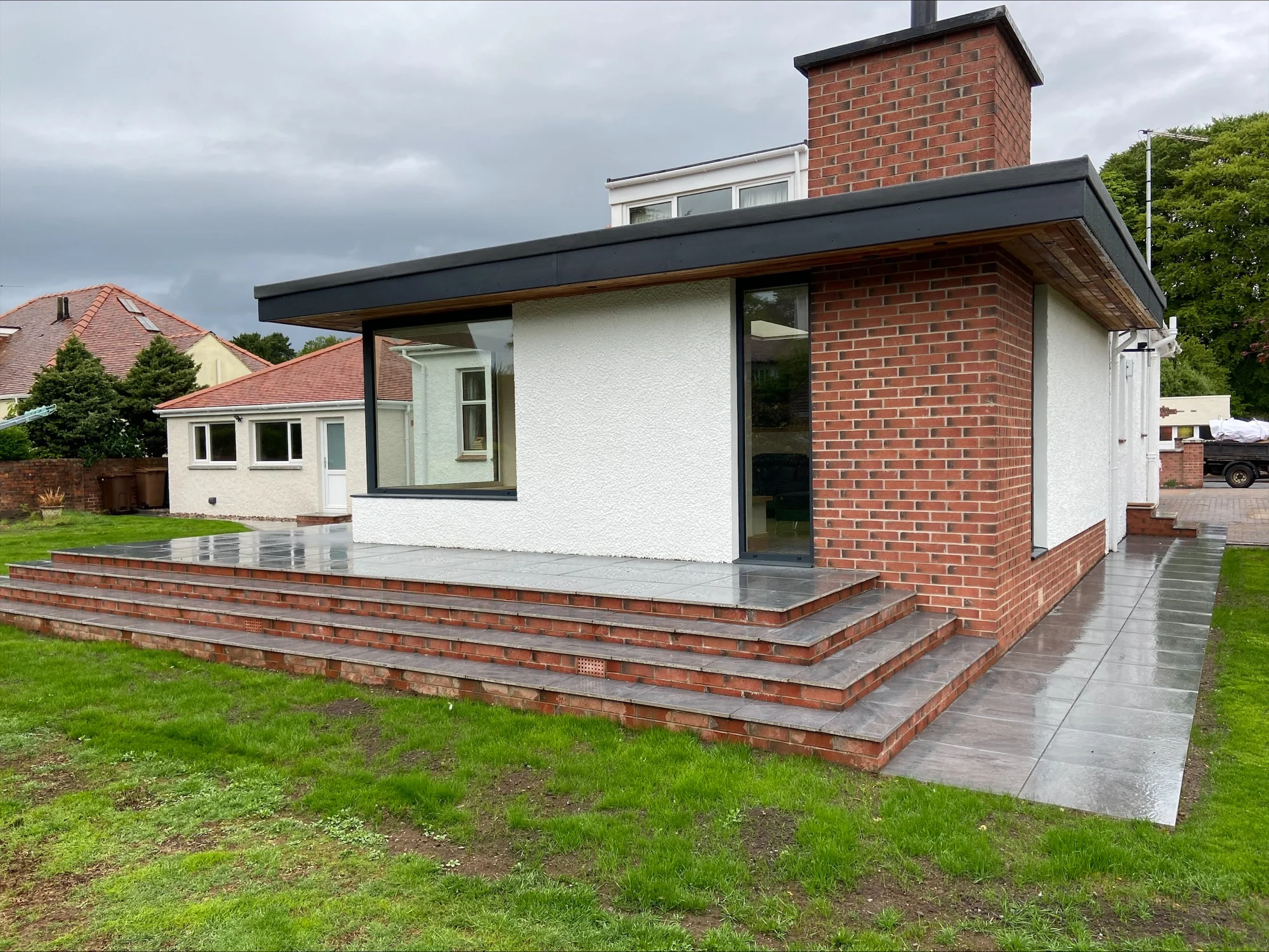
A ground-level patio at the back of a house is usually permitted development in Scotland. Raised platforms are different: decking or a terrace with a floor more than 0.5 metres above the ground generally needs planning permission, and there are extra limits in conservation areas and at listed buildings. The mygov.scot guide to adding decking or a raised platform sets out the basics. If the new surface goes between your house and the road, the rules on porous surfaces apply, as explained in the guide to laying a hard surface. We check this at the design stage so there are no surprises.
Choosing patio installers in Ayrshire
A patio is a big outdoor floor, so it is worth asking any installer a few questions before you sign:
- How deep will the sub-base be, and what goes into it?
- Will the slabs be fully bedded, and primed if they are porcelain?
- Which way will the water go, and how will the patio meet the house?
- Can I see patios you laid a few years ago, not just last month?
- Who looks after planning questions, drainage and any steps or walls?
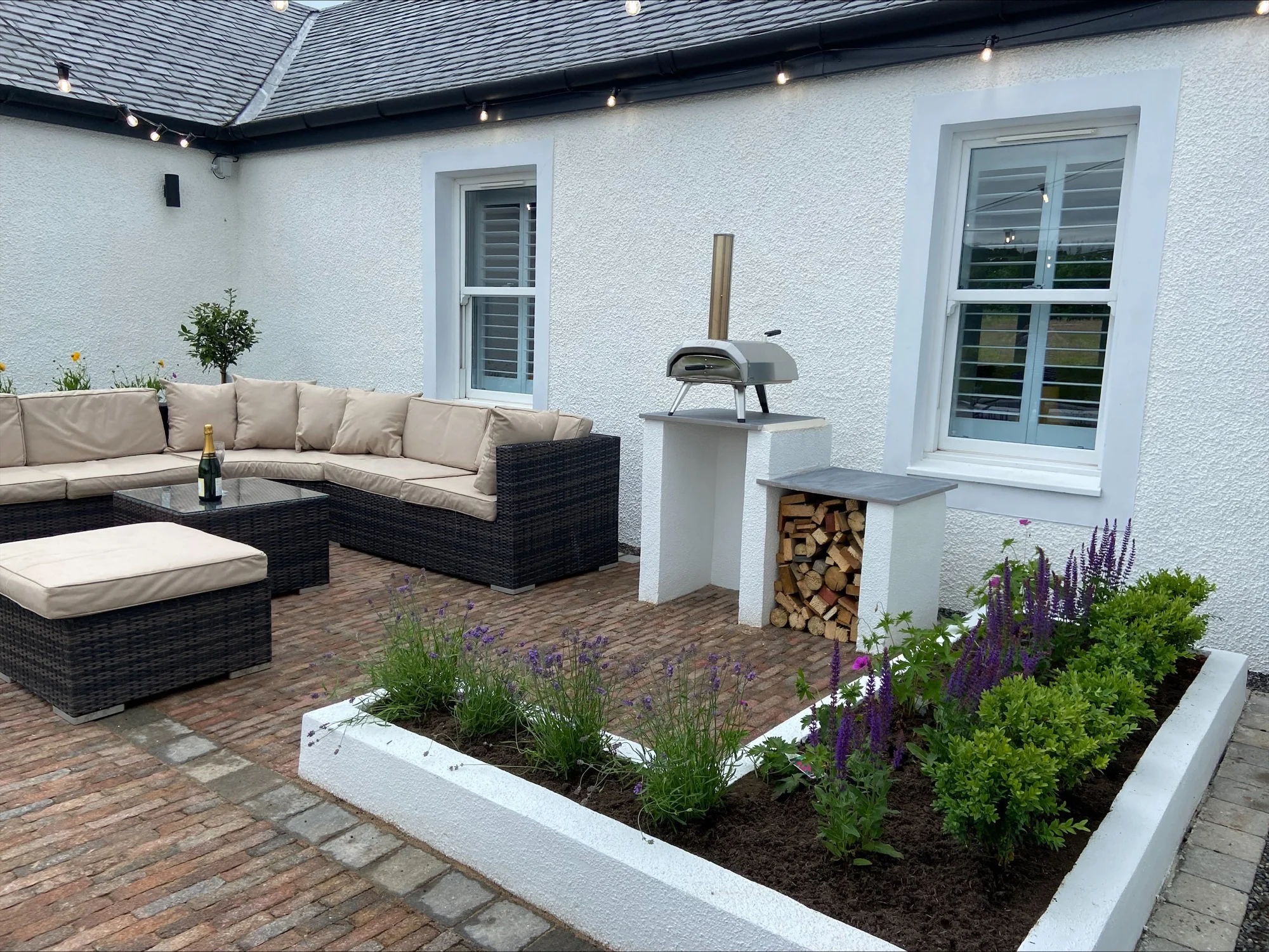
Because we build houses as well as gardens, our patios are planned alongside the extension, garage or garden room they connect to, with levels, drainage, lighting and power sorted before the paving goes down. At Burton Cottage that meant a sheltered courtyard garden and resin driveway designed with the rest of the renovation, and at our Scottish Renovation project the entrance walkways were designed in-house to suit the new extensions. If you are planning a new driveway at the same time, our guide to resin driveways for coastal weather covers that side, and our garden room office guide has ideas for using the garden all year.
Patio FAQs
Can a patio be laid in winter?
Excavation and sub-base work can often go ahead, but mortar and jointing should not be laid in frost or heavy rain. Winter is a good time to design the patio and book the work, so it is ready for spring.
Is porcelain slippery when wet?
It depends on the slab. Outdoor porcelain should have a textured, anti-slip finish; smooth indoor tiles should never be used outside. Keeping the surface clear of moss and leaves matters for any material.
Can you replace or relevel an old patio?
Yes. Sometimes the existing slabs can be lifted and relaid on a new base; sometimes it is better to start again. We will look at the base and drainage before recommending either.
Plan your patio or terrace with RHA Construction
Whether it is a simple patio outside the back door or a terrace, steps and courtyard garden around a new extension, we can design and build it for you anywhere in and around Ayr. As your local builder in Ayr, we handle everything from groundwork to the final joint. Call us on 07790 666673, email info@rhaconstruction.uk or use the button below to arrange a site visit and quote.